
That’s a good question.
Science practicals are handled in a few different ways, depending on the topic and the year group.
For younger students, we often use home practicals.
These are simple, safe experiments using everyday household items.
Things like planting seeds.
Using vinegar and other common kitchen materials.
Students can carry these out at home and record what they did and what they observed.
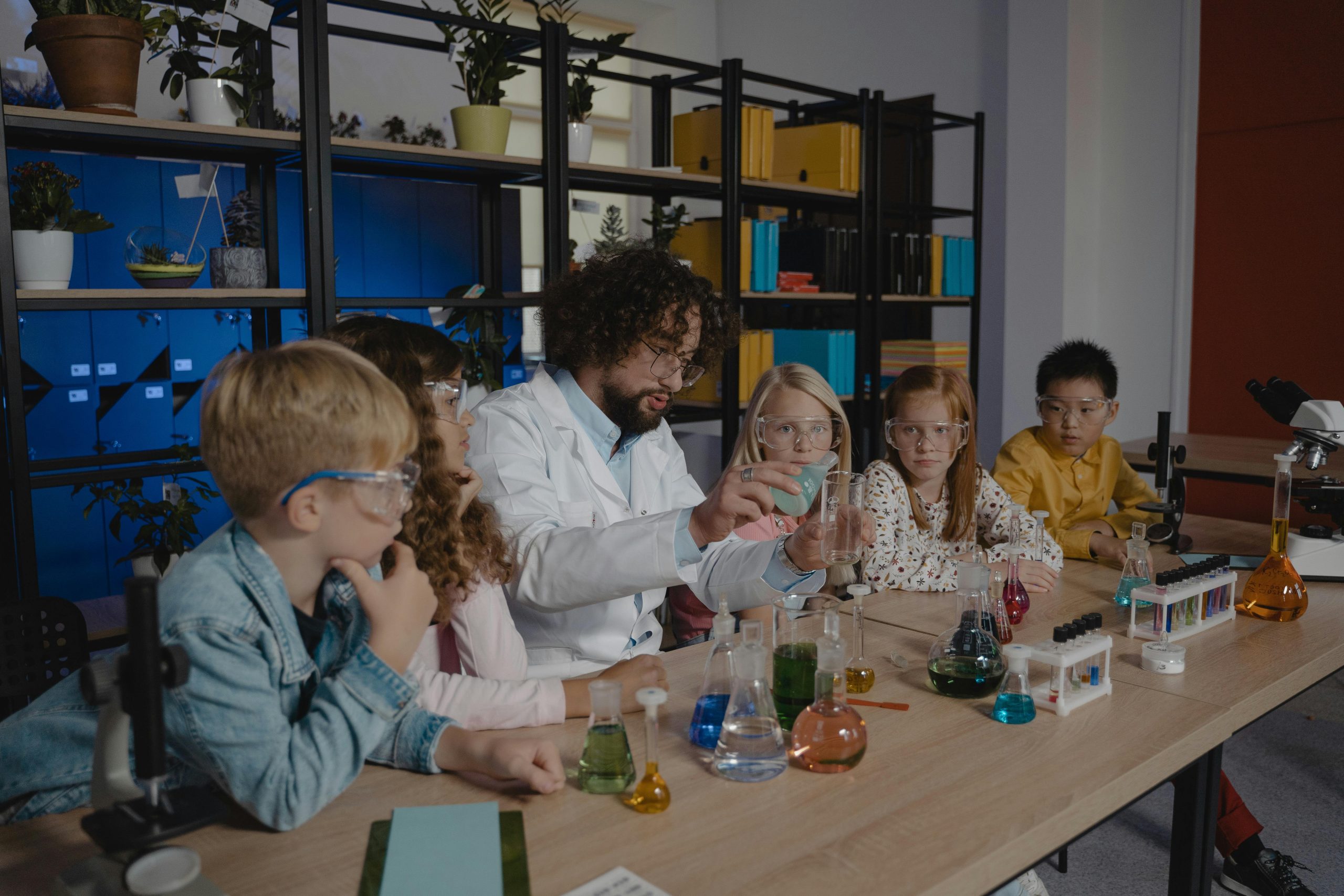
In other cases, the teacher carries out the experiment live on camera, while students watch.
The teacher explains each step as they go, and students are able to ask questions in real time.
We also use videos where appropriate.
Professional science videos are shown in class, paused at key moments, and explained carefully by the teacher so students fully understand what’s happening and why.
For older students, particularly at A-Level, it works slightly differently.
Because we offer international A-Levels, the course is split into AS Level in Year 12 and A-Level in Year 13.
For these specific international A-Level subjects, there are no required practical exams.
That makes it much more straightforward for students to complete the qualification.
Even so, when practical concepts need to be taught, teachers still use a range of methods.
This might be live demonstrations on camera.
Virtual labs.
Or guided video demonstrations explained in detail during the lesson.
So while students are learning online, practical science concepts are still taught clearly, visually, and effectively — in a way that works within an online environment and aligns with the exam requirements.
Your Attractive HeadingThat’s a good question.
Science practicals are handled in a few different ways, depending on the topic and the year group.
For younger students, we often use home practicals.
These are simple, safe experiments using everyday household items.
Things like planting seeds.
Using vinegar and other common kitchen materials.
Students can carry these out at home and record what they did and what they observed.
In other cases, the teacher carries out the experiment live on camera, while students watch.
The teacher explains each step as they go, and students are able to ask questions in real time.
We also use videos where appropriate.
Professional science videos are shown in class, paused at key moments, and explained carefully by the teacher so students fully understand what’s happening and why.
For older students, particularly at A-Level, it works slightly differently.
Because we offer international A-Levels, the course is split into AS Level in Year 12 and A-Level in Year 13.
For these specific international A-Level subjects, there are no required practical exams.
That makes it much more straightforward for students to complete the qualification.
Even so, when practical concepts need to be taught, teachers still use a range of methods.
This might be live demonstrations on camera.
Virtual labs.
Or guided video demonstrations explained in detail during the lesson.
So while students are learning online, practical science concepts are still taught clearly, visually, and effectively — in a way that works within an online environment and aligns with the exam requirements.